
I just found out about this Chinese phone app called Are You Dead?
That’s the actual name of the app, not some translation error or weird, hyper-specific joke that didn’t survive the conversion to English. Are You Dead? has gone viral in China, rapidly climbing the download charts, because it addresses the very specific, very modern, fear that you might die alone in your apartment… and that no one would notice for weeks or months.
The whole thing is pretty simple. Once a day, you open the app and press a big green button to check in. That’s it, all you do is push a button that confirms you’re still alive. It’s like the ultimate participation trophy: you get to be not-dead for another twenty-four hours, assuming your thumb still functions well enough to satisfy some algorithm in a Beijing data center. If you fail to check in for a set number of days, the app sends a message to your designated emergency contact saying, in essence, “Hey. You should maybe go look at this person.”
It’d be easy to dismiss it as being ironically grim or even culturally specific, but the part that sticks with me is not that the app exists. What sticks with me is the fact that the thing is so successful because enough people looked at their lives and thought, Yes. This is a plausible thing that I should be prepared for.
At some point, the fear that nobody would notice your absence stopped being philosophical. Which raises the question of how we ended up here.
I think a big part of this comes from a flavor of isolation that, as a species, we’re just not programmed for. Despite being more connected than ever, we’ve also somehow managed to become more isolated than ever… from people, from the greater world around us, from everything. And that isolation isn’t just social. It shows up in more subtle ways, like the fact that we don’t even go outside anymore without consulting a summary of what’s already happening there.
The first thing I see when I pick up my phone in the morning is the weather. It’s not even an app: it just sits on my phone’s home screen, a neatly packaged report telling me what it’s doing right now, what it’ll do later, and how I should feel about it, all illustrated by little icons doing their best to look like they know what they’re talking about.
I remember getting up for school when I was a kid in the ’80s and making wardrobe decisions based on what the world was actually doing at that exact moment. If it was raining, you wore a jacket, and if it was nice out in the morning and rained later, you got wet. If you were lucky, maybe someone made note of the weather forecast from the previous night but, for the most part, weather was something you experienced physically, publicly, and in real time.
The weather arrives with documentation now. Rain doesn’t count unless it has a percentage attached to it and a picture of a tiny cloud that looks mildly concerned about your life choices. Wind is meaningless without an arrow explaining where it emigrated from. Tomorrow’s forecast brought to you on YouTube… like, share, and subscribe!
We live on social media. Facebook, Instagram, the hellscape that used to be Twitter… even LinkedIn, if you have a high tolerance for emotional distress disguised as professional enthusiasm. We maintain connections with people we would have completely lost touch with just a generation ago, often without remembering how we met them in the first place. We know when a former coworker from a job we left fifteen years ago gets a haircut, when a distant cousin from that side of the family adopts a dog, or the exact brand of oat milk favored by the spouses of people we barely know. We exist in this constant, low-grade hum of social presence, but actual interaction has become something we do at a distance… if we do it at all.
We’ll stand silently in line at a coffee shop staring at our phones, arguing with people we’ve never met on the other side of the planet, while carefully avoiding eye contact with human beings three feet away from us. Somehow, speaking to them feels like a risk we’re just not prepared to take.
We don’t even know our neighbors. We share walls, ceilings, and parking lots with people whose existence we primarily register through muffled footsteps and occasional irritation, but we have no idea what they do or what their voices sound like, and if we know their names it’s only because it appears on a Wi-Fi network. We say that we don’t interact with people anymore because we’re busy, or tired, or overstimulated, but the truth is simpler and a little more uncomfortable: somewhere along the way, we stopped assuming that other people are mostly harmless. It isn’t fear so much as uncertainty, the kind that makes it easier to keep a little more distance.
Instead of addressing that uncertainty and unfamiliarity, we’ve built elaborate methods of managing the anxiety it produces, like doorbell cameras and motion-activated lights. Neighborhood apps and Facebook groups send alerts when someone unfamiliar drives down a street they are entirely allowed to be on, grainy black-and-white footage of a van with a painting of a wizard on the side driving by at 2:14 AM, immediately uploaded with the caption: Does anyone recognize this vehicle??? No, Janice. Nobody recognizes it. That’s the problem.
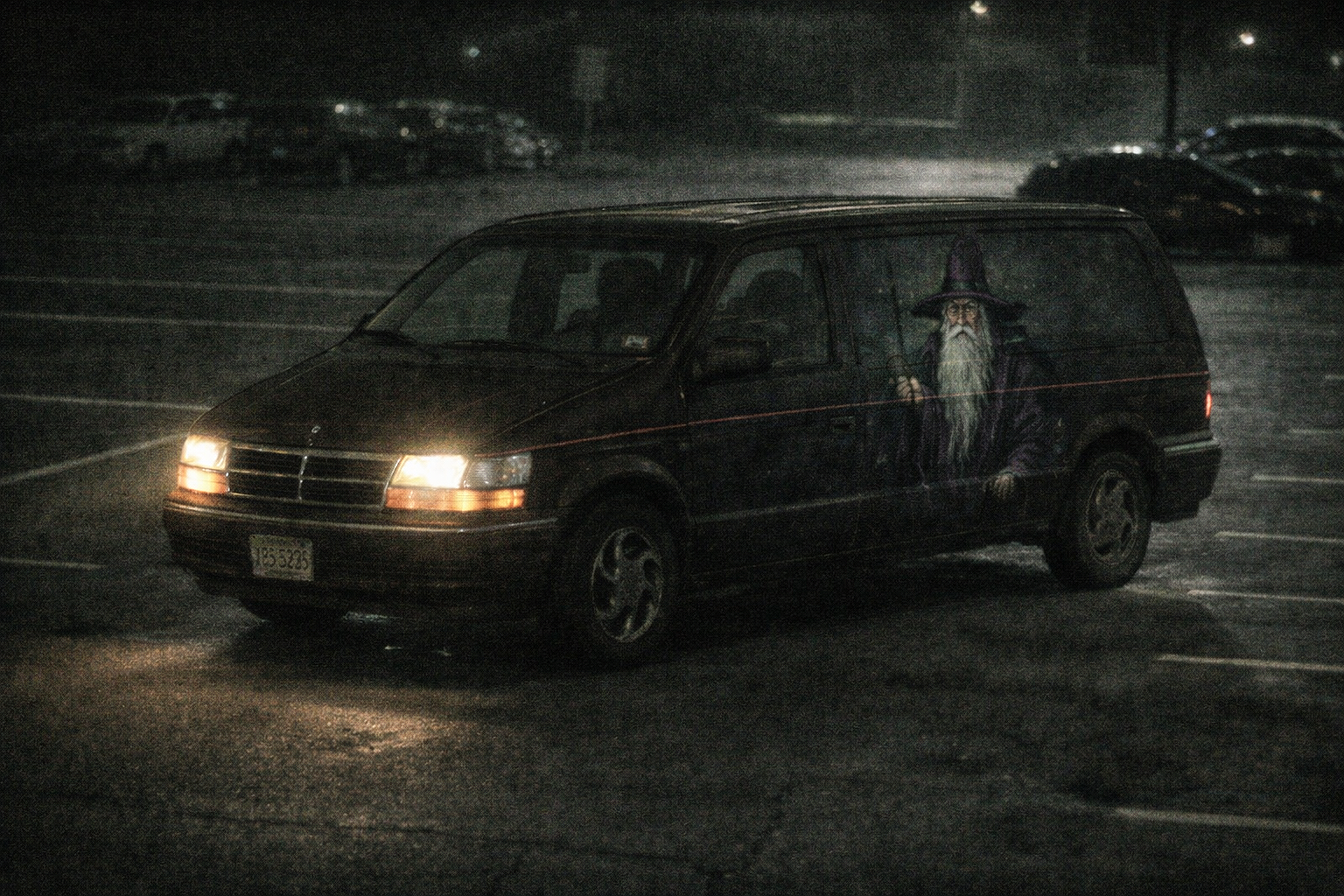
We’ve replaced familiarity with surveillance, monitoring our neighborhoods like low-budget intelligence agencies that primarily specialize in teenagers with backpacks and dudes who over-invested in airbrush fantasy art and are trying to find a parking spot without triggering a four-state digital manhunt for a mobile drug lab. We’re gathering data and drawing conclusions without context, and then we act surprised when it fails to make us feel safer.
In the ’80s and ’90s, we were taught to be cautious, but that caution had limits. Stranger danger was framed as the exception, not the rule, and the common expectation was still that most people were fine. You were advised to be careful and not to get into any vans with murals of wizards on the side, which felt specific enough to be useful, but we were never advised to withdraw from society entirely. At some point, however, that balance tipped and the assumption that everyone you don’t know is a potential problem became the standard.
Now, sequestered in our homes, we barely even venture out to do our shopping or order food. Malls lie bleaching in the sun like marooned whale carcasses while we sit in darkness, ordering off Amazon. We get our food delivered, and if the restaurant doesn’t offer delivery, we’ve got a myriad of food delivery services to handle that for us. Then we don’t even interact with the people bringing us the stuff we need to survive because “leave at door” is now the pre-checked option.
There’s a comfortable little choreography to the whole thing. You hear a car or truck pull up, footsteps in the hallway or on the porch, and you pause whatever you’re doing and wait… not for any reason other than that this is the part where you’re supposed to wait. The footsteps stop. There’s a soft thump, followed maybe by the sound of someone clearing their throat… just in case you were considering opening the door at the wrong moment. The footsteps retreat, and only then do you start breathing again.
Sometimes the app sends you a photo confirming that the food has arrived. It’s usually a close-up of a crumpled bag of food sitting in front of your door, taken by someone crouching slightly, like they’re photographing a rare bird that startles easily, just to prove that the exchange happened without either party having to acknowledge that the other actually exists. There’s no awkward small talk about the weather, or how sweet the wizard artwork on the side of the delivery driver’s van is. You tip through the app. Sometimes, the food is even still warm!
We wanted safety, but we got isolation with infrared lighting instead. It turns out that doorbell footage is not a substitute for names, neighborhood apps and Facebook groups are a poor replacement for waving at someone and saying hello… and piles upon piles of unopened mail and uncollected food deliveries aren’t going to make anybody actively wonder whether you’re still alive behind that door.
Listen, I’m not suggesting that we all revert to some aggressively wholesome vision of community where everyone knows everyone else’s business and distressing mid-century casseroles or meat-based Jell-O abominations appear on patios unannounced. I am suggesting that it might be counterproductive that our response to feeling unsafe was to reduce the amount of actionable information we have about the people physically closest to us, because the safest version of the world probably isn’t one where we are all sealed inside our homes, silently monitoring each other and relying on a phone app to alert people if we’ve died.
It’s one where, if something goes wrong, somebody would notice.
Maybe even someone who knows your name.
AJH
Hey!
Do you want to read this kind of long-form foolishness, published much more often than three or four times per decade? And maybe also some shorter foolishness that won’t be posted on this site?
Then you should check out my Substack!
See you there (hopefully)!
AJH


 Just West of Hell